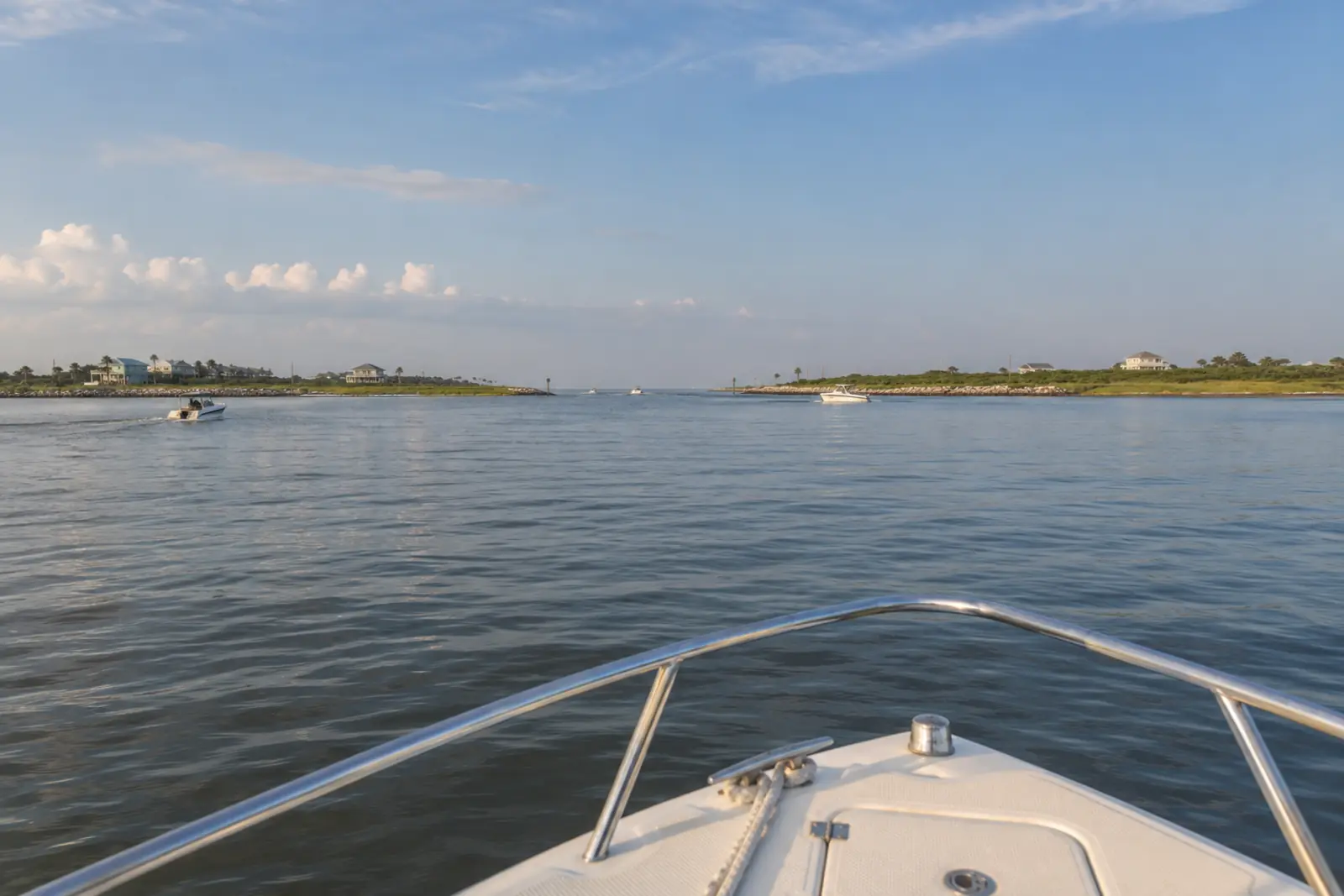
Houston sits within an hour's drive of four boating environments that each behave differently on the water: Clear Lake, a sheltered coastal lake; Galveston Bay, the big saltwater bay it opens into; Lake Conroe, a large reservoir bordering the Sam Houston National Forest; and Lake Houston, a quieter freshwater lake on the city's northeast edge. Here is what to expect at each one, with access points, water conditions, and the details that shape what you can realistically do on a given day.
Clear Lake
Clear Lake is the primary base for Houston boat rentals and sits between Webster, Seabrook, and Kemah, roughly 25 miles southeast of downtown. It connects to Galveston Bay through the dredged Clear Creek channel, so a calm afternoon on the lake can extend into open bay water when conditions allow. Because the lake sits inside a ring of marinas and developed shoreline, it stays sheltered from open-bay wind on most days, and summer mornings are typically smooth before the southeast breeze builds by midday. Clear Lake Park (5001 NASA Pkwy, Seabrook) has the main public boat ramp on the lake.
For dining by boat, the main destination is the Kemah Boardwalk, at the mouth of Clear Creek where the channel opens into Galveston Bay. The channel from Clear Lake is marked with lights and daybeacons and is a no-wake zone, so plan on a slow run through it. Several waterfront restaurants around the lake and at the boardwalk have docks where you can tie up while you eat. Day-docking rules vary, so check with the restaurant before you go.
Clear Lake also works well for evening rentals. The Kemah Boardwalk lights up at night, wind typically drops after sunset, and the run back across the lake with reflected marina lights is one of the most popular ways to end a rental day in the area.
Galveston Bay
Galveston Bay covers 600 square miles of saltwater flats and open reaches between the Houston Ship Channel and the Bolivar Peninsula. The average depth is 6 to 10 feet over a flat muddy bottom, with deeper cuts running along the shipping channel. The bay is big water that behaves like it: tidal range is small (typically 0.1 to 1.4 feet, mostly wind-driven), but a 15 mph southeast wind builds a 1 to 2-foot chop quickly on the shallow bottom, and 20 mph is genuinely rough for a flat-bottomed pontoon.
The bay is reached from Clear Lake through Clear Creek. On days when the NOAA Houston/Galveston marine forecast shows winds under 15 mph, morning departures are comfortable for open-bay cruising. The sea breeze typically picks up between 11 a.m. and 1 p.m. in summer, so planning a return to Clear Lake before noon on windier days is worth doing.
The Houston Ship Channel is a federal deep-water navigation channel that crosses Galveston Bay from Galveston to the Port of Houston. Large commercial tankers and container ships use it and have very limited ability to maneuver or stop. Give them a wide berth and cross the channel at a right angle, quickly. If you head out onto the bay, carry a VHF radio and keep it on channel 16. There are also security zones around LNG facilities and petrochemical plants in the bay complex that recreational boats may not enter. The Lone Star Harbor Safety Committee publishes a free mariners' guide for the Houston-Galveston waterways (available at lonestarhsc.org) that covers the channel crossings and security zones in detail.
On the fishing side, Galveston Bay is one of the most productive saltwater fisheries in Texas, with speckled trout, redfish, and flounder found around its reefs, grass flats, and shorelines. Texas Parks and Wildlife publishes current bag limits; saltwater fishing in Texas requires a Texas fishing license with a saltwater endorsement, available at tpwd.texas.gov. Our guide to pontoon fishing rentals in Houston covers tackle, regulations, and the best spots in more depth.
Lake Conroe
Lake Conroe is a freshwater reservoir of about 20,000 acres, about 40 miles north of Houston, reached via I-45 North to the Willis or Conroe exits. The San Jacinto River Authority (SJRA) manages water levels and publishes the lake rules. The lake sits partly within the Sam Houston National Forest, which gives the shoreline a wooded character and limits shoreline development on the national forest side.
Public ramps include the US Forest Service's Cagle and Scott's Ridge recreation areas on the national forest side of the lake. SJRA keeps the current list of public access points at sjra.net.
SJRA's lake rules set no-wake distances around docks, shorelines, bridges, and anchored boats, and the residential canals, including those in Walden on Lake Conroe, Bentwater, and April Sound, are no-wake zones. The full current rules are posted on the San Jacinto River Authority website at sjra.net. Lake Conroe runs warmer than the bay and is usually calmer, making it a practical choice for tubing and swimming from late May through September. For a full day-trip breakdown from Houston, including driving time and what to pack, see the Lake Conroe pontoon rental day-trip guide.
Lake Houston
Lake Houston covers about 12,000 acres and sits 25 miles northeast of downtown off US-59 and FM 1960, near the Atascocita and Huffman communities. The City of Houston operates it as a water supply reservoir through Houston Public Works, which sets its own access rules separate from TPWD. Deussen Park on the western shore has a public boat ramp and parking.
Water clarity drops noticeably after heavy rain due to sediment from the East Fork of the San Jacinto River, so the window between rains is the best time to go. Weekday rentals see far less boat traffic here than on Clear Lake or Lake Conroe, and the wide, open lake arms give a lot of room to spread out. For a direct comparison of what each lake offers for a rental day, see Lake Houston vs. Lake Conroe: best lake for your boat rental.
Seasonal conditions across all four spots
March through May is the most consistent window. Water temperatures are rising, afternoon wind is lighter than summer, and holiday crowds have not arrived. Memorial Day through Labor Day is the busiest period: Clear Lake and Lake Conroe are at their busiest on Fridays and Saturdays, and heat index temperatures in July and August regularly reach 105 degrees, so starting before 10 a.m. matters for comfort. October and November bring cooler mornings, reliable calm afternoons, and some of the best bay fishing of the year. December through February rentals are viable when temperatures stay above 50 and wind is calm. Houston rarely ices, so a clear winter day on Clear Lake is genuinely pleasant. For a month-by-month breakdown of conditions and crowd levels, see the seasonal guide to renting a boat in Houston.
Texas boating rules that apply to all four spots
Texas requires every boat operator born on or after September 1, 1993, to hold a Boater Education Certificate from an approved provider to drive a motorboat over 15 horsepower. On a captained rental, nobody in your group needs one. All vessels must carry one Coast Guard-approved Type I, II, or III life jacket per person aboard, plus a throwable Type IV device on boats 16 feet or longer. On Galveston Bay, carrying a VHF radio is strongly recommended. Speed limits are enforced by Texas Parks and Wildlife Game Wardens on all four bodies of water, and wake violations in posted no-wake zones carry fines. The full rule set for Houston-area boaters is covered in our guide to Texas boating laws for Houston renters.
Frequently Asked Questions
Can I take a rental boat from Clear Lake into Galveston Bay?
Yes. Clear Lake connects to Galveston Bay through the dredged Clear Creek channel, which puts you at the Kemah Boardwalk area and then out into open bay water. The practical limit is wind: sustained southeast winds above 15 mph build short choppy waves quickly on the bay's shallow floor, making a flat-bottomed pontoon uncomfortable. A morning departure before the sea breeze picks up gives you the best window for open-bay time.
Is Lake Conroe's water cleaner than Clear Lake?
Lake Conroe is a freshwater reservoir on the West Fork of the San Jacinto River and does not carry the tidal sediment or saltwater turbidity of Clear Lake and Galveston Bay. Visibility in 2 to 3 feet is typical on calm days, which makes it a practical choice for swimming and tubing. Runoff after heavy rain temporarily lowers clarity.
Can I take a rental pontoon or deck boat on Buffalo Bayou?
Not with a rental pontoon. The downtown stretch of Buffalo Bayou is narrow and mostly paddled by kayaks and canoes. To see it from the water, the Buffalo Bayou Partnership runs guided tours on its own pontoon boat, Spirit of the Bayou, from Allen's Landing downtown. For a self-drive rental, Clear Lake is the nearest practical water.
How far in advance should I book for a holiday weekend?
Memorial Day, July 4th, and Labor Day weekends fill up quickly on Clear Lake and Lake Conroe. Booking two weeks ahead is a practical target for those peak dates. Weekday and fall rentals are generally available on shorter notice, and same-day reservations are sometimes possible on quieter days.
Are life jackets provided in the rental?
Rental companies normally provide a Coast Guard-approved life jacket for each person aboard, plus the required throwable Type IV device on boats 16 feet or longer, but confirm before you go. Texas law requires children under 13 to wear a life jacket whenever the boat is underway.
For current conditions on a specific spot, check the managing agency's website and the National Weather Service marine forecast before you go.